Why Your Best Outfits Keep Going Unworn — And the Simple Fix That Changes Everything

There's a blazer in the back of my closet — deep emerald green, perfect cut, genuinely one of the best things I've ever bought — that I forgot I owned for eight months. Eight months. I was out here complaining that I had nothing to wear while that blazer sat in the dark, still in great shape, absolutely ready to go.
Sound familiar? You're not alone, and honestly, you're not even being careless. There's actual psychology behind why we cycle through the same four outfits on repeat while an entire wardrobe full of perfectly good pieces collects dust. Once you understand what's happening in your brain, fixing it becomes a whole lot easier.
The Real Reason You Default to the Same Outfits
Here's the thing: getting dressed is a decision. And decisions are exhausting — especially when you're making them first thing in the morning before coffee, before your brain is fully online, and often under some kind of time pressure.
Psychologists call this decision fatigue. The more choices you're presented with, the more your brain wants to shortcut the process. So instead of scanning your entire closet thoughtfully, your eyes go straight to what's familiar. The jeans you wore Tuesday. The white tee that's always reliable. The rotation you've built up almost by accident.
It's not that you love those pieces more than everything else. It's that your brain has already pre-approved them. They're the path of least resistance.
Meanwhile, the emerald blazer? It requires a little more thought. What do I wear it with? Is it too much for today? Your brain, already overloaded, quietly skips it. Day after day. Until you've forgotten it exists.
Visual Clutter Is Making It Worse
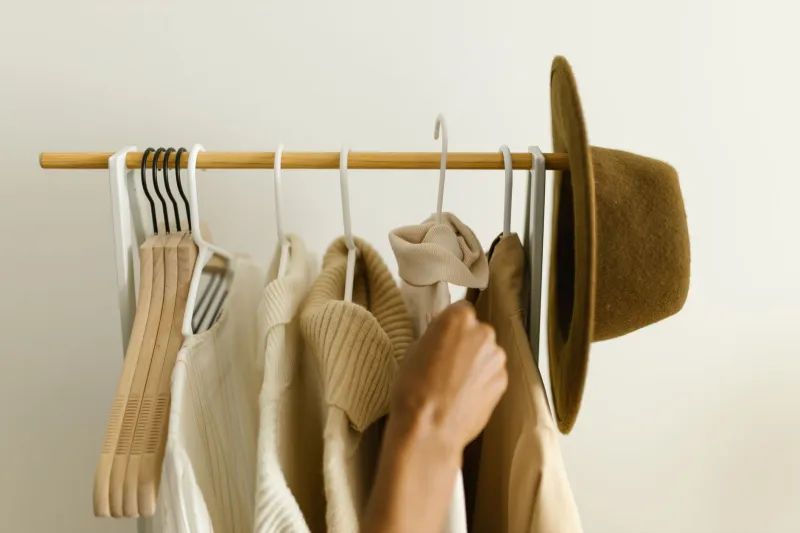
There's another layer to this: when a closet is visually chaotic — different hanger sizes, clothes crammed together, things folded in messy stacks — your brain can't actually process what it's seeing. Studies on consumer behavior have shown that cluttered visual environments reduce our ability to make satisfying choices. We get overwhelmed and retreat to the familiar.
This is why you can stand in front of a packed closet and genuinely feel like you have nothing to wear. It's not about quantity. It's about your brain's ability to see what's actually there.
When clothes are crowded together, they visually merge. That emerald blazer disappears into the dark blur of everything around it. Out of sight, out of mind — even when it's technically right in front of you.
The Organizational Hacks That Actually Work
You don't need to buy a single new thing to fix this. What you need is a system that makes your closet easier for your brain to read.
Turn your hangers around. This one sounds almost too simple, but it's genuinely effective. Flip all your hangers so they face backward. When you wear something and return it, hang it the normal way. After 30 days, anything still facing backward hasn't been touched. Those are your forgotten pieces — and your new styling challenge.
Group by outfit potential, not by category. Most people organize by type: all pants together, all tops together, all dresses in a row. Try reorganizing by color family or by outfit groupings instead. When a blazer lives next to the tops and pants that actually work with it, you're way more likely to grab the whole combination. You're removing the mental labor of pairing things in real time.
Give your forgotten pieces front-row placement. After doing the hanger audit, move your underused items to the most visible, accessible spots in your closet. Eye level, center rod, easy reach. The pieces you default to can live on the edges for a while. Force your eyes toward what you've been ignoring.
Use a "try it this week" rack or section. Designate a small area — even just five hangers — for pieces you're committing to actually wear in the next seven days. It takes the decision out of the morning rush. You've already pre-decided. Now you just have to show up.
Resetting Your Relationship With What You Own
Beyond the organizational stuff, there's a mindset shift worth making. A lot of us treat our closets like storage rather than a resource. We shop, we bring things home, and then we mentally file them away as "owned" without ever really integrating them into how we get dressed.
Try spending 20 minutes this weekend doing what I call a slow scroll through your own closet. Not to declutter, not to donate — just to look. Pull things out. Try combinations you've never tried. Photograph the ones that actually work so you have a reference on rushed mornings. (Your camera roll as a lookbook? Genuinely underrated move.)
You'll almost always find at least three or four pieces you'd completely written off that turn out to be exactly what your wardrobe needed. The forgotten pieces aren't usually the failures — they're often the ones you bought because something genuinely excited you, and then never gave a real chance.
The Shopping Pause That Pays Off
Here's the part I really want you to sit with: most of the time when we feel the urge to shop, what we're actually feeling is boredom with our current rotation. Not a genuine gap in our wardrobe.
When you address the closet blindness — when you reorganize, rediscover, and actually start wearing what you already own — that shopping itch tends to quiet down on its own. Because suddenly you have options you forgot existed. Suddenly the emerald blazer is in your Tuesday outfit and you remember why you loved it in the first place.
The most stylish people aren't necessarily the ones who shop the most. They're the ones who genuinely know what they own and know how to use it. That kind of relationship with your wardrobe takes a little intention — but it costs absolutely nothing.
Your closet already has the goods. You just need to let yourself see them again.