Why Your Mirror Is Gaslighting You (And How to Finally See Your Outfits Clearly)
The Real Reason Your Outfits Look Better in Stores Than at Home
You know that specific kind of frustration — you buy something, you love it in the store, you bring it home, and something is just off. The color reads differently. The fit feels less polished. The whole thing seems to lose whatever made it exciting when you first tried it on.
Nine times out of ten, the item hasn't changed. Your lighting has.
This is one of the most underestimated factors in personal style, and almost nobody talks about it. We spend time thinking about fit, color theory, body proportion — but we almost never examine the actual conditions under which we're evaluating our clothes. And those conditions matter enormously.
Light doesn't just illuminate your outfit. It actively shapes how color, texture, and fit are perceived. The wrong light doesn't just make you look tired — it makes your clothes look wrong in ways that are genuinely hard to diagnose.
The Problem With Fitting Room Lighting (Yes, It's Intentional)
Here's something worth knowing: retail stores are not neutral environments. The lighting in most dressing rooms is engineered to make you feel good about what you're trying on. Warm, slightly directional lighting smooths out texture, flatters skin tone, and makes colors pop in ways that feel exciting in the moment.
That's not inherently manipulative — but it does mean you're evaluating pieces under optimized conditions that your home bathroom mirror will never replicate. When you get home and stand under a single overhead bulb or a window that faces north, the same garment can look completely different.
The color you fell in love with might look dull or washed out. The fabric that seemed structured might read as stiff or cheap. The fit that felt effortlessly relaxed might just look baggy. None of this means the piece is bad — it means you're finally seeing it under neutral (or worse, actively unflattering) conditions.
What Different Light Sources Are Actually Doing to Your Wardrobe
Understanding a few basics about light quality goes a long way toward diagnosing why certain pieces keep getting passed over in your morning rotation.
Overhead lighting — especially the kind that comes from a single ceiling fixture directly above you — casts downward shadows that emphasize texture and create contrast. It can make wrinkles in fabric look more pronounced, and it tends to make colors look slightly muddy or flat depending on the bulb temperature.
Cool or blue-toned light (often found in bathrooms with daylight-balanced bulbs) is harsh on warm colors. Rust, camel, warm red, olive — these all look significantly less appealing under cool light. If your bathroom runs cool, you might be unconsciously avoiding your warmest pieces because they "never look right."
Warm or yellow-toned light does the opposite — it makes warm tones glow but can make cooler colors like navy, cobalt, or bright white look dingy or off.
Natural daylight is the closest thing to a neutral baseline, but it shifts throughout the day and varies dramatically based on which direction your windows face. North-facing windows give the most consistent, cool-neutral light. South-facing windows can be warm and beautiful in the morning but harsh and overexposed in the afternoon.
How to Build a Lighting Setup That Actually Tells You the Truth
You don't need to renovate your home or invest in a ring light and a photography backdrop. A few targeted adjustments can make a significant difference in how accurately you see yourself getting dressed.
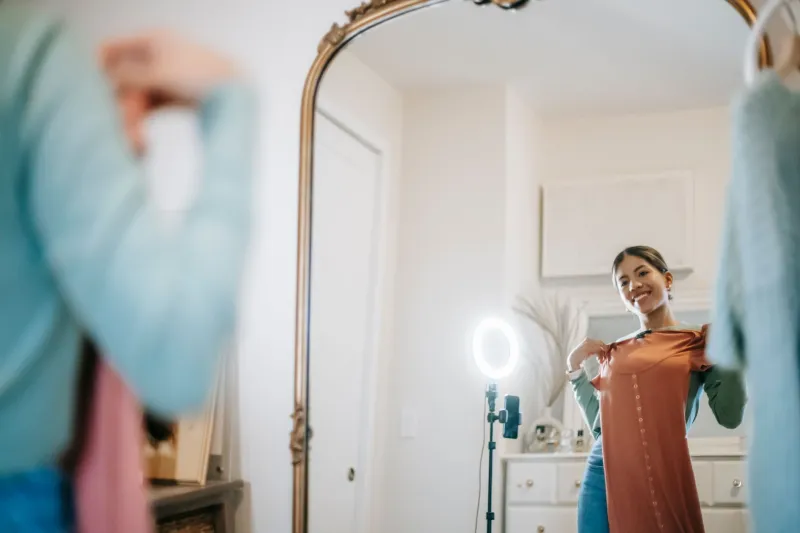
Get a full-length mirror out of the bathroom. Bathroom lighting is almost universally bad for outfit evaluation. It's typically overhead, often cool, and the space is too small to see yourself from a real distance. If your only full-length mirror is in the bathroom, moving it to a bedroom or hallway is one of the single best things you can do for your daily getting-dressed experience.
Flank your mirror with light, don't light from above. The most flattering and accurate lighting for seeing yourself clearly comes from light sources positioned at roughly eye level, on either side of you. This is the same principle behind a well-lit vanity mirror, and it works just as well for full-length outfit checks. Two simple floor lamps or wall sconces on either side of your mirror will change everything.
Choose bulbs in the 3000K–4000K range. This sits between warm and cool — close enough to neutral daylight that colors read accurately without being harsh. Look for bulbs labeled "soft white" or "neutral white" rather than "daylight" (which tends to run too blue) or "warm white" (which skews too yellow).
Do a daylight check when something feels uncertain. If you're genuinely unsure about a piece — whether it works, whether the color is doing what you think it is — take it to a window during the middle of the day and look at it in natural light. It's the closest thing to a ground truth you have at home.
The Confidence Piece Nobody Mentions
Here's the thing that doesn't get said enough: a lot of the self-criticism that happens in front of the mirror isn't about your body or your taste. It's about bad information. When the light is working against you, you make decisions based on a distorted picture — and those decisions compound over time.
You stop reaching for certain colors because they "don't work on you." You avoid pieces that actually fit beautifully because they looked off that one morning in the bathroom. You convince yourself your style instincts are broken when really, you've just been working with bad data.
Fix the lighting, and you fix the feedback loop.
A Quick Checklist Before You Dismiss Another Piece
Next time you try something on and it doesn't feel right, run through this before you write it off:
- Am I standing under a single overhead light?
- Is the bulb in this room noticeably warm or cool?
- Am I too close to the mirror to see the full silhouette?
- Have I tried this in natural light?
If the answer to any of those is yes, the problem might not be the outfit. It might just be the room.
Your clothes deserve to be seen in conditions that give them a fair shot. And honestly — so do you.