Why You Keep Buying Clothes You Never Wear — And How to Finally Stop
Let's be real for a second. You've done it. I've done it. We've all stood in front of a closet stuffed with clothes, tags still dangling from half of them, and thought, I have nothing to wear.
That's not a storage problem. That's not even a budget problem. That's a buying-things-you-don't-actually-want problem — and it's way more common than anyone talks about. The good news? Once you understand why it happens, you can stop the cycle for good.
The Aspirational Trap Is Real (And It's Working On You)
Here's a scenario that might feel familiar. You're scrolling through Instagram or TikTok, you see someone living what looks like an effortlessly chic life, and suddenly you need that linen blazer, those wide-leg trousers, that whole vibe. So you buy it. And then it sits in your closet because — surprise — your actual life involves commuting, running errands, and grabbing tacos on a Tuesday night, not attending rooftop events in SoHo.
This is aspirational shopping, and it's one of the sneakiest psychological traps in fashion. You're not buying clothes for the life you have. You're buying them for the life you imagine having. And there's nothing wrong with dreaming, but your wardrobe needs to work for right now, not for some hypothetical future version of you.
Before you click "add to cart," ask yourself: When, specifically, would I wear this in the next 30 days? Not "someday at a nice dinner" — an actual occasion on your actual calendar. If you can't name one, put it down.
Social Media FOMO Is Dressed Up as Trend Advice
The algorithm is not your stylist. I say that with love, but it needs to be said.
Trend content is designed to create urgency. "This is THE shoe of the season." "You need this color in your closet NOW." It's engineered to make you feel behind, like everyone else already has the thing and you're the only one who missed the memo. That anxiety is not style intuition — it's FOMO in a trench coat.
The real tell? When a trend genuinely excites you, you'll find yourself thinking about how it fits into what you already love. When it's FOMO talking, you'll feel a vague pressure to have it without being able to explain why. Pay attention to that difference. It's quieter than the hype, but it's a lot more honest.
The Dressing Room Moment You're Skipping
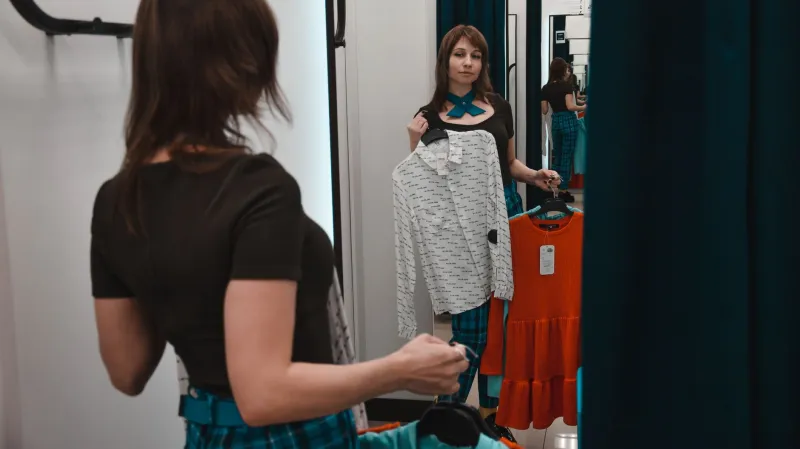
One of the most useful things you can do — whether you're shopping in-store or online — is give yourself a full-life stress test before committing to anything.
Try this: When you're considering a piece, don't just think about how it looks. Think about how it functions.
- Can I style this with at least three things I already own?
- Does it fit the way I actually dress day-to-day, or does it require a whole new outfit ecosystem?
- Am I in love with the item, or am I in love with how it looked on someone else?
- If this weren't on sale, would I still want it?
That last one is a gut-punch for a reason. Discounts are one of the biggest drivers of wardrobe clutter. A 60% off price tag makes your brain register a deal, not a decision. But a bargain on something you don't need is still money spent on something you won't wear.
Do a "Wear Audit" on Your Closet Right Now
Here's a quick exercise that gets brutally honest results. Go through your closet and pull out everything you haven't worn in the last three months (accounting for season, obviously). Now look at those pieces and ask: Why didn't I reach for this?
You'll probably notice patterns. Maybe it's a bunch of "occasion" pieces that never found an occasion. Maybe it's items that technically fit but don't feel like you when you put them on. Maybe it's trendy purchases that felt exciting in the store but weird in your actual life.
Those patterns are your data. They're telling you exactly what kinds of purchases to stop making. The goal isn't a perfect capsule wardrobe or some minimalist ideal — it's a closet that reflects who you actually are, not who you were trying to be on a Tuesday afternoon when the algorithm caught you at a weak moment.
Getting Honest About Your Actual Style Identity
Here's the thing about personal style: it's not about having the "right" clothes. It's about knowing yourself well enough to shop for yourself instead of for an image.
That means getting clear on a few things:
Your real lifestyle. Not your aspirational one. If you work from home four days a week and spend weekends hiking or at kids' soccer games, your wardrobe should reflect that reality — with room for the occasional elevated moment, sure, but not a closet full of pieces that only work for a social life you don't have.
What makes you feel good. Not what's trending, not what looks good in a flat lay. What do you put on and immediately feel like yourself? More of that, please.
Your actual color comfort zone. It's fine to experiment, but if you've bought three "statement" pieces in colors you never end up wearing, that's a sign. Some people are neutrals people. Some people love color. Neither is wrong, but fighting your instincts is expensive.
The One Question That Changes Everything
If I had to boil all of this down to a single filter for every shopping decision, it would be this:
Am I buying this because I want it, or because something made me feel like I should want it?
That "something" could be a sale, an influencer, a trend cycle, a mood, or the subtle pressure of watching everyone around you seem to have their style figured out. None of those are good enough reasons to spend your money.
You deserve a wardrobe that actually serves you — one that makes getting dressed feel easy instead of overwhelming, and that reflects the real, specific, interesting person you already are. That starts with getting honest about why you shop the way you do.
Once you see the pattern, you can't unsee it. And that's when the fun part begins — shopping with intention, building a closet you actually love, and never standing in front of a full rack thinking you have nothing to wear again.